
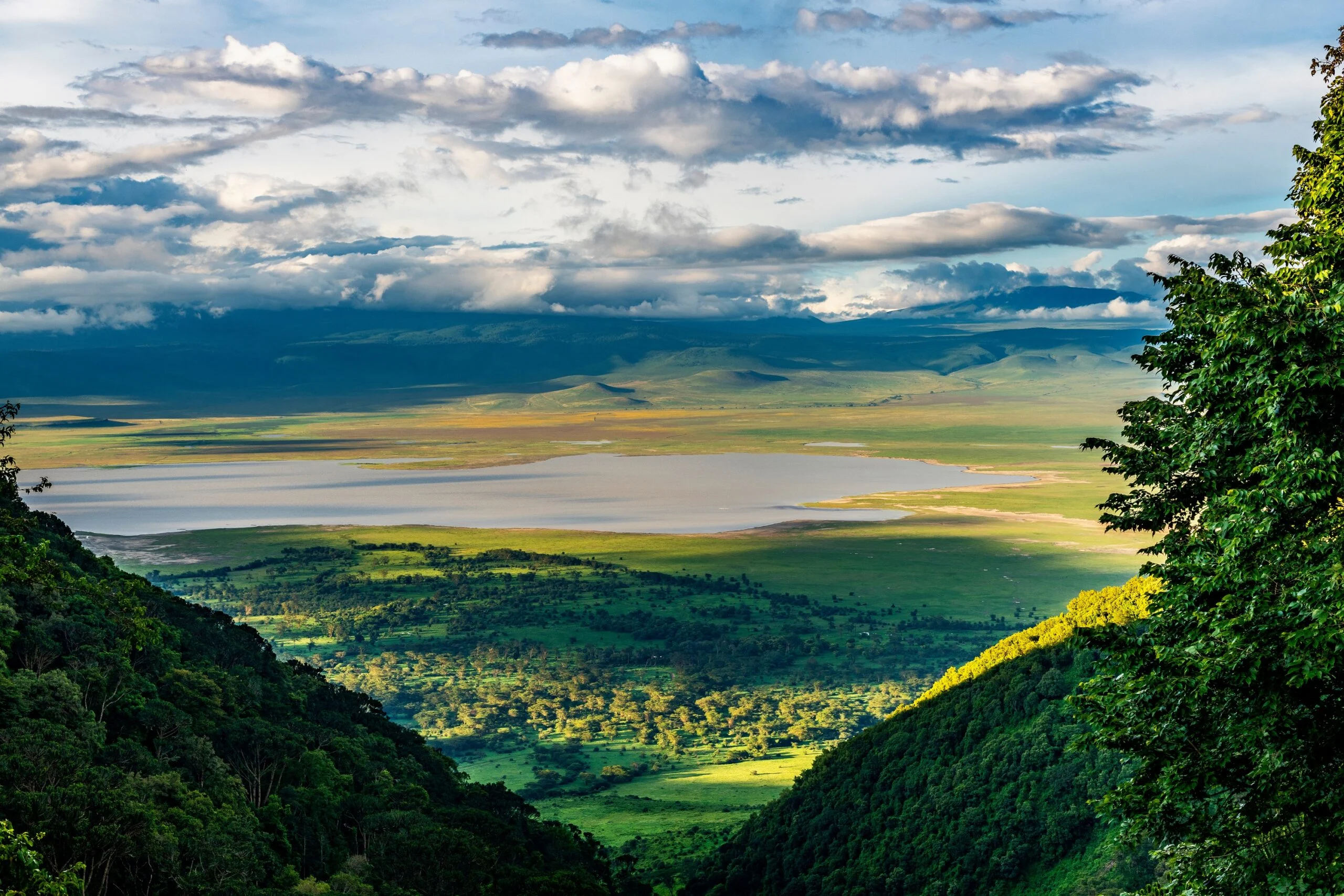
Ngorongoro Conservation Area
Step into a world where nature’s grandeur meets prehistoric history. The Ngorongoro Conservation Area (NCA) is a UNESCO World Heritage site and a “multiple land-use” area, unique for its harmonious coexistence of wildlife and the semi-nomadic Maasai people. At Banana Africa Adventures, we invite you to descend 600 meters into the Ngorongoro Crater—the world’s largest unbroken volcanic caldera—to witness the highest density of big game in Africa. Our local expertise and authoritative guiding ensure a professional and deeply immersive safari experience in this “Garden of Eden.”
History and Facts about
The Ngorongoro Conservation Area was established in 1959, separating from the Serengeti National Park to allow for a pioneer conservation model where indigenous people live alongside wildlife.
- The Caldera’s Origin: Formed roughly 3 million years ago, a massive volcano—once estimated to be as tall as Mt. Kilimanjaro—collapsed, leaving behind a 260 $km^2$ floor that acts as a natural enclosure for over 25,000 large animals.
- Cradle of Mankind: The NCA is home to the world-renowned Olduvai Gorge, where the Leakey family discovered fossils and footprints proving human habitation dating back nearly 3.6 million years.
- Global Recognition: Recognized as a UNESCO World Heritage site (1979) and a Biosphere Reserve, it remains the only place on earth where you can see the “Big Five” in a single four-hour game drive.
Wildlife and Attractions in
The Ngorongoro Crater floor is a self-sustaining paradise, boasting a permanent population of animals that rarely leave the safety of its walls. Banana Africa Adventures takes you to the heart of this wildlife-packed haven.
- Big Five Stronghold: The crater is one of the most reliable places in Tanzania to spot the endangered Black Rhinoceros. It also supports the densest known population of lions and massive “tusker” elephants.
- Predator Action: Beyond lions, the area is home to spotted hyenas, cheetahs, and elusive leopards lurking in the Lerai Fever Tree Forest.
- Avian Spectacles: Over 500 bird species inhabit the area. Lake Magadi, a shallow alkaline lake, is often shimmering pink with thousands of lesser and greater flamingos, while the plains host the heavy Kori bustard and the elegant Grey Crowned Crane.
The Great Wildebeest Migration
While the migration is synonymous with the Serengeti, the Ngorongoro Conservation Area serves as the vital starting point for this epic 800 km journey. The short-grass plains of the southern NCA are where the “Greatest Show on Earth” begins its yearly cycle.
- The Calving Season: From December to March, over 1.6 million wildebeest and hundreds of thousands of zebras gather in the Ndutu region of the NCA. During a peak three-week window, approximately 8,000 calves are born every day.
- Nutritional Lifeline: The volcanic soils of the Ngorongoro highlands provide grass rich in calcium and magnesium, essential for lactating mothers and growing calves.
- Predator Gauntlet: This massive influx of vulnerable young creates a magnet for apex predators, offering travelers some of the most intense and raw wildlife sightings in all of East Africa