
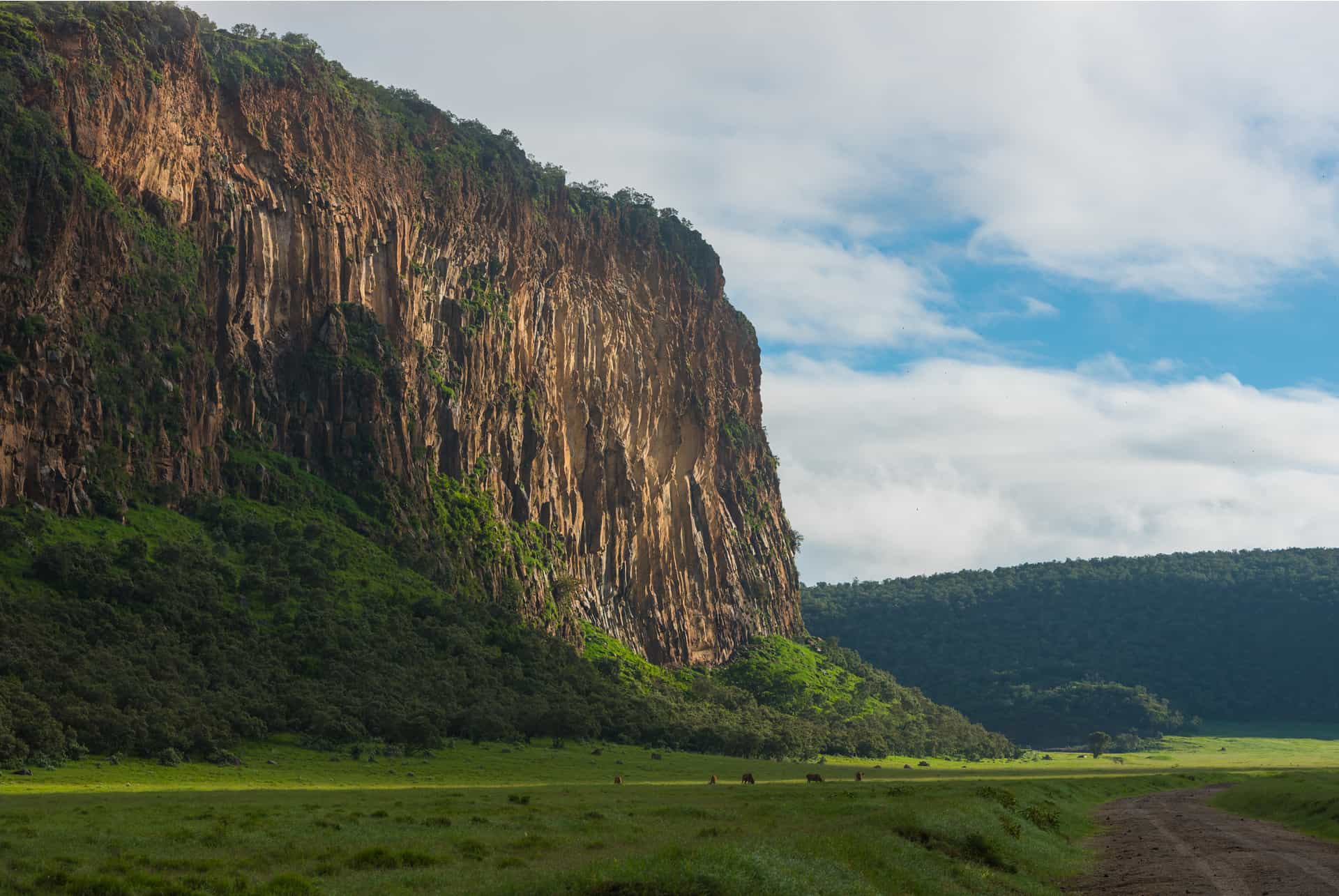
Hell’s Gate National Park
Experience the raw, prehistoric beauty of Hell’s Gate National Park, a unique destination in the Great Rift Valley where the traditional safari vehicle is optional. Known for its towering cliffs, deep gorges, and geothermal wonders, Hell’s Gate offers an active adventure that is rare in African wildlife reserves. At Banana Africa Adventures, we invite you to cycle alongside zebras and hike through ancient volcanic landscapes. Our professional guides provide the expertise and local authority needed to explore this “interactive” park safely, making it a perfect addition to any Kenyan itinerary.
History and Facts about Hell’s Gate National Park
Established in 1984, Hell’s Gate is one of Kenya’s most geographically significant and accessible parks.
- The Name: The park was named by explorers Gustav Fischer and Joseph Thomson in 1883, inspired by a narrow break in the towering cliffs that was once a tributary of a prehistoric lake.
- Geological Marvel: The park is a volcanic wonderland, featuring obsidian caves and two extinct volcanoes, Olkaria and Hobley’s. It is also home to the Olkaria Natural Health Spa, which utilizes the area’s intense geothermal activity.
- Cinematic Inspiration: Its dramatic scenery served as the primary inspiration for the landscapes in the 1994 film The Lion King, and it was a major filming location for Lara Croft: Tomb Raider – The Cradle of Life.
- Unique Freedom: Covering roughly 68 $km^2$, it is one of the only national parks in Kenya where visitors are permitted to hike, cycle, and rock climb freely among the wildlife.
Wildlife and Attractions in Hell’s Gate National Park
Hell’s Gate packs immense variety into its compact borders, offering sights and activities that challenge the standard safari mold.
- Fischer’s Tower: A 25-meter-high volcanic plug, Fischer’s Tower is a popular site for rock climbing and is steeped in Maasai legend as a fossilized figure of a chief’s daughter.
- Hell’s Gate Gorge: The park’s signature attraction, this narrow chasm features water-eroded walls, hot springs, and spectacular rock strata. A guided hike here reveals the powerful forces that shaped the Rift Valley.
- Accessible Wildlife: Because of the lack of large predators like lions, you can safely view herds of plains zebra, eland, Coke’s hartebeest, and Thomson’s gazelle from your bicycle or on foot.
- Raptor Stronghold: The park’s 120-meter cliffs are a critical breeding ground for rare birds of prey, including the Lammergeier (bearded vulture), Verreaux’s eagle, and thousands of swifts.
The Great Wildebeest Migration
While the thundering movement of 1.5 million animals is the hallmark of the Masai Mara, Hell’s Gate National Park provides a vital and tranquil contrast to the high-energy migration circuit.
- A Strategic Stopover: For travelers with Banana Africa Adventures, Hell’s Gate is a key link between the big-game spectacle of the Mara and the avian wonders of Lake Naivasha. It offers a “slow safari” experience where you can see migration species like zebras and wildebeest in a stationary, geological setting.
- Ecological Contrast: While the Great Migration is a search for green grass across vast plains, life in Hell’s Gate is defined by the permanent geothermal springs and the sheltering cliffs of the Rift Valley.
- The “Quiet” Migration: Visitors can observe the same species that participate in the Great Migration without the crowds of hundreds of safari vehicles, providing a more intimate and personal connection to the animals.
- The Complete Journey: We often use Hell’s Gate as the “prologue” to the Great Migration, allowing you to walk among the herds before heading to the Mara to witness the raw drama of the river crossings.