
Lake Manyara National Park
Step into the “loveliest lake in Africa,” as famously described by Ernest Hemingway. Lake Manyara National Park is a jewel of northern Tanzania, offering a diverse array of ecosystems packed into a compact and stunning landscape. From the lush groundwater forests to the shimmering alkaline waters of the lake, this park provides a unique safari experience that perfectly complements its larger neighbors. At Banana Africa Adventures, we invite you to explore this vibrant sanctuary, where the Great Rift Valley escarpment meets a paradise of flamingos and legendary tree-climbing lions. Trust our local authority and expert guiding to deliver a professional, intimate, and unforgettable journey into the heart of Manyara.
History and Facts about Lake Manyara National Park
Lake Manyara has a long-standing reputation as a center of biological diversity, serving as a vital link in the northern Tanzania safari circuit.
- Establishment: The area was first gazetted as a game reserve in 1957 and officially upgraded to National Park status in 1960.
- UNESCO Biosphere Reserve: In 1981, it was established as a UNESCO Biosphere Reserve, recognizing its importance in protecting a wide range of habitats, from mountain forests to wetlands.
- Compact Diversity: Covering roughly 330 $km^2$, the lake itself occupies up to two-thirds of the park area during the wet season. Despite its size, it hosts an incredible variety of vegetation zones, including ground-water forests, acacia woodlands, and open grasslands.
- The “Manyara” Name: The name is derived from the Maasai word emanyara, a species of Euphorbia plant used to create protective enclosures (bomas) for their livestock.
Wildlife and Attractions in Lake Manyara National Park
Though smaller than the Serengeti, Lake Manyara packs a powerful wildlife punch, offering sightings of some of Africa’s most unique animal behaviors.
- Tree-Climbing Lions: The park is world-famous for its tree-climbing lions. While rarely seen elsewhere, the lions here have developed the habit of lounging in ancient acacia trees to escape insect bites and the heat of the ground.
- Elephant Sanctuary: Manyara is home to one of the highest concentrations of elephants in Tanzania, often seen moving through the dense ground-water forest near the park entrance.
- Primate Paradise: The forest canopy teems with life, including massive troops of olive baboons and the playful blue monkeys.
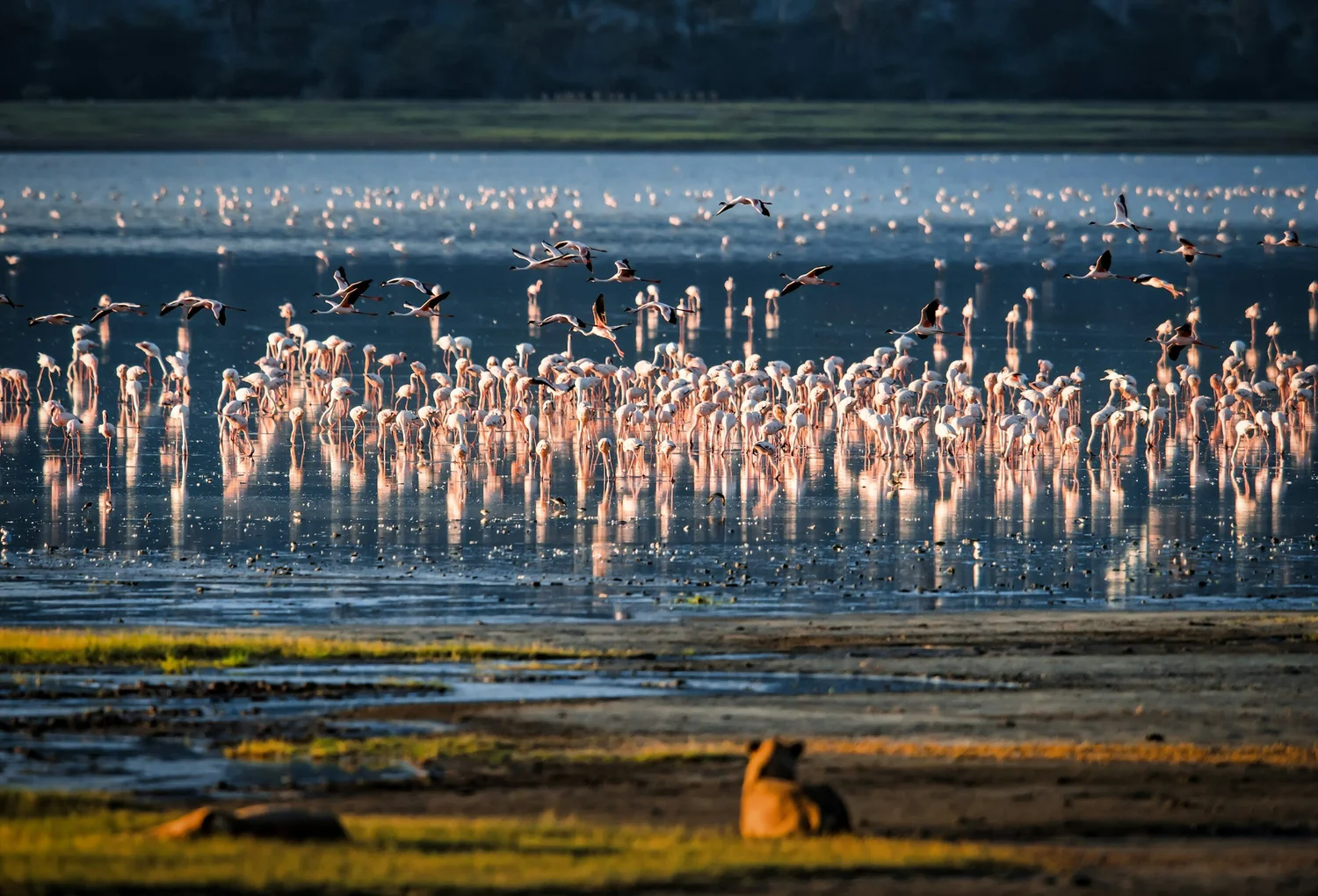
- Flamingos and Birdlife: Over 400 bird species have been recorded here. The lake’s alkaline shores are often painted pink by thousands of Lesser Flamingos, alongside pelicans, storks, and cormorants.
- Geological Marvels: The park is situated at the base of the 600-meter-high Rift Valley Escarpment, featuring the Maji Moto hot springs—geothermal vents that bubble to the surface at nearly 60°C.
The Great Wildebeest Migration
While the world-famous Great Migration follows a path primarily through the Serengeti and Ngorongoro, Lake Manyara plays an essential role as a lush, year-round sanctuary within the broader regional ecosystem.
- The Migration Connection: Lake Manyara is connected to the nearby Tarangire National Park via the Kwakuchinja Wildlife Corridor. This allows animals like wildebeest and zebras to move between the parks in search of water and grazing.
- Resident Herds: While it does not host the 1.5 million animals of the Great Migration, Lake Manyara maintains its own resident herds of wildebeest and zebras that gather on the grassy floodplains surrounding the lake.
- Strategic Safari Stop: For travelers with Banana Africa Adventures, Lake Manyara is a vital stop on the way to the Serengeti. It offers a “prologue” to the migration, allowing you to see the species involved in a more intimate, forested setting before they hit the open plains.
- A Sanctuary of Plenty: Because of its permanent groundwater and springs, Manyara serves as a critical refuge for wildlife during the dry seasons when other parts of the northern circuit become parched.