
Tsavo East National Park
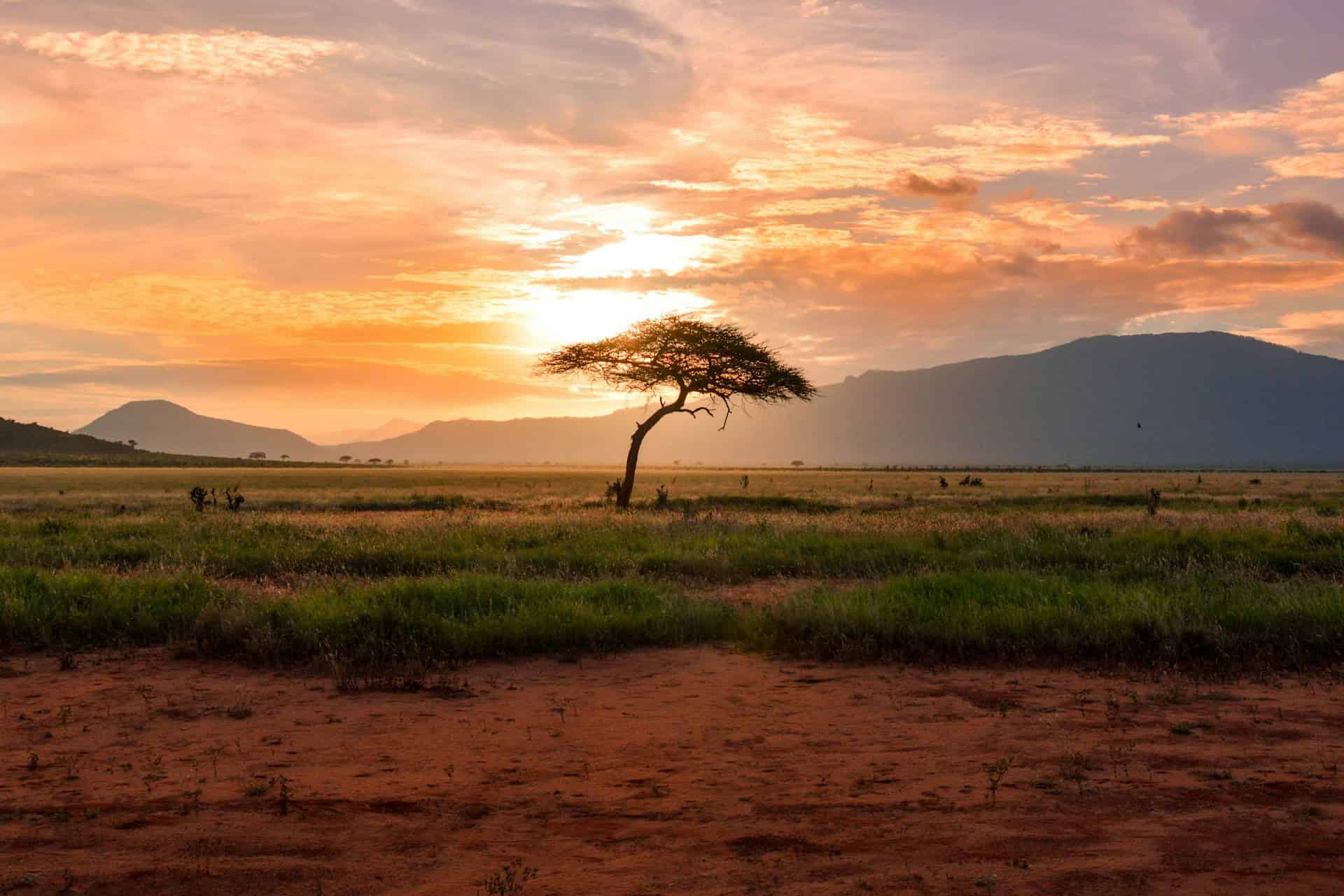
Welcome to the vast, sun-drenched plains of Tsavo East National Park, Kenya‘s oldest and largest protected area. Spanning nearly 14,000 $km^2$, this “Theatre of the Wild” offers a raw, unfiltered safari experience defined by its flat, semi-arid landscapes and the striking red soil that colors its famous inhabitants. At Banana Africa Adventures, we invite you to explore this legendary wilderness where the horizon stretches forever and the history is as deep as the volcanic soil. With our expert guides and professional service, you’ll discover the hidden gems of the Athi-Galana-Sabaki River system and the massive “red” elephants that call it home.
History and Facts about Tsavo East National Park
Tsavo East is a land where ancient geology meets colonial legend. Established in April 1948, it was carved out of the Taru Desert to protect one of the world’s most significant biodiversity strongholds.
- World’s Longest Lava Flow: The park is home to the Yatta Plateau, a 290 km-long geological marvel formed by ancient lava flows from Ol Doinyo Sabuk Mountain.
- The Legend of the Man-Eaters: Tsavo is historically famous for the “Man-Eaters of Tsavo”—a pair of lions that terrorized railway construction workers in 1898, a story that has become synonymous with the park’s wild reputation.
- Conservation Milestones: Since its inception, Tsavo East has been a pioneer in anti-poaching and elephant conservation, famously supporting “Super Tuskers”—elephants like the late Satao and Dida whose tusks reached the ground.
- Aruba Dam: Built in 1952 along the Voi River, this man-made reservoir has become a critical lifeline, attracting thousands of animals during the dry season.
Wildlife and Attractions in Tsavo East National Park
Tsavo East offers a unique wildlife spectacle characterized by massive herds and rare specialists. Banana Africa Adventures ensures you witness the “theatre” of nature in all its glory.
- The Famous “Red Elephants”: The park is world-renowned for its elephants, which appear vibrant red after wallowing in the local iron-rich volcanic dust.
- Maneless Lions: Unlike their cousins in the Mara, many male lions in Tsavo are maneless or have very thin manes—an adaptation to the heat and thorny scrubland.
- Mudanda Rock: A massive 1.6 km inselberg that acts as a natural water catchment. It provides a stunning vantage point to watch hundreds of elephants and buffaloes drink at the dam below.
- Lugard Falls: Named after Captain Lugard, these rapids on the Galana River feature bizarrely eroded rock patterns and are home to giant crocodiles and hippos.
- Rare Species: Beyond the Big Five, keep an eye out for the Gerenuk (the long-necked “giraffe gazelle”), the Lesser Kudu, and over 500 bird species, including the ostrich and martial eagle.
The Great Wildebeest Migration
While the world-famous Great Migration of 1.5 million animals is the hallmark of the Serengeti-Mara ecosystem, Tsavo East National Park provides a critical and distinct regional narrative.
- A Different Movement: Tsavo East does not host the 800 km wildebeest circuit. Instead, it features its own regional migration of elephants and zebras that move through the Tsavo Conservation Area, spanning 22,000 $km^2$ between Tsavo East, Tsavo West, and Tanzania’s Mkomazi.
- The Dry Season Refuge: While the Great Migration is a search for grass, wildlife in Tsavo migrates toward the permanent waters of the Galana and Tsavo Rivers.
- Ecological Contrast: Many travelers with Banana Africa Adventures choose Tsavo East as a “quiet” alternative to the crowded Mara river crossings. Here, you witness the survival of species in a semi-arid desert environment, a raw contrast to the lush savannahs of the west.
- The Migration Corridor: The park acts as a vital corridor for wide-ranging species, ensuring that even without the “Great Migration” title, the park remains a dynamic and ever-changing theater of movement and survival.